HISTORY
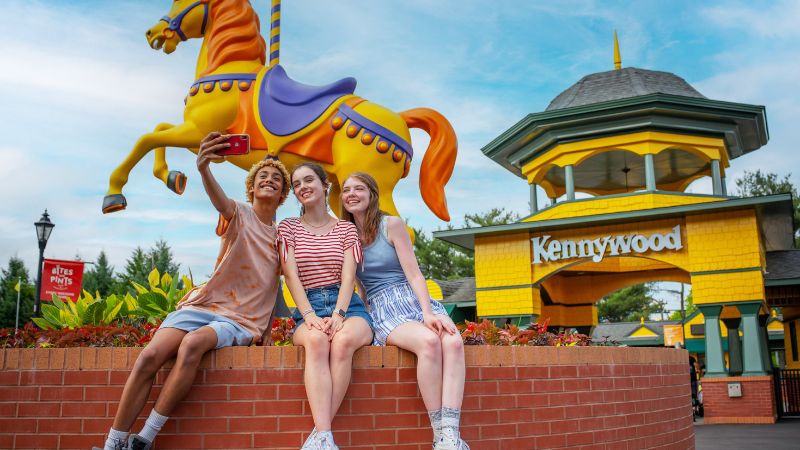
Founded in 1898 as a small trolley park near Pittsburgh, Kennywood was begun
by the Monongahela Street Railway Company,
which was controlled by Andrew Mellon. Today's
Kennywood still contains two major buildings
dating from 1898 -- a carousel pavilion and
a restaurant (originally the Casino).
At the turn of the century, Kennywood was engaged in a fierce battle for survival
with about a dozen other trolley parks and
amusement resorts in Western Pennsylvania.
The Pittsburgh Street Railway Company wanted
to get out of the amusement park business in
1902 so it subleased the park to first a Boston
Company and later to a group from Aspinwall.
In 1906, Pittsburgh Railway Company assigned
its lease to A.S. McSwigan and Frederick W.
Henninger.
Many changes occurred between 1900 and 1930. In the early 1910's, Kennywood built
two large roller coasters: The Racer and the
Speed-O-Plane. Important rides added in the
1920's were three coasters: Jack Rabbit (Designed
by Miller and Baker in 1920), Pippin (designed
by John Miller in 1924), and Racer in 1927
replacing the old Racer built in 1910. The
park added a huge swimming pool in 1925.
The Great Depression from 1930 to 1935 was especially hard on the park. Dancing
helped keep the park in business during this
period as great dance bands played in the park
from 1930 to 1950. Kennywood prospered in the
second half of the 1930's as new rides including
Noah's Ark (1936) were added. During the Second
World War period, the park couldn't add new
rides, but it did buy a used ferris wheel and
a miniature train. It still operates the latter.
In the 1950's school picnics grew by leaps and bounds. The park added many new
rides to Kiddieland. Some popular rides in
this period included the Hurricane, the Looper,
the Rotor (the first ride imported from Europe),
the Wild Mouse and the Octopus. With the 1960's
and 1970's came competition from "Disneyland" and other theme parks. Kennywood decided to spend the money necessary to remain
competitive. The Turnpike was built in 1966
followed in 1968 by the Thunderbolt, which
was redesigned from the Pippin by resident
coaster whiz, Andy Vettel. With the Thunderbolt
came the designation "The Roller Coaster Capital of the World." The Dance Pavilion, a dark ride since the 1950's, burned in 1975.
In the 1980'sand 1990's Kennywood had to keep
up with changes in the amusement industry.
They added the Raging Rapids in 1985. The park
was designated a national historic landmark
in 1987. One of the most popular additions
to the park was a new steel-looping coaster
the Steel Phantom in 1991. The Steel Phantom's
top speed was 80 MPH, its longest drop was
225 feet and it featured 4 loops. The park
continued to grow with it's largest expansion
ever in 1995 Lost Kennywood. This replica of
the Luna Parks from the turn of the century
houses some of the parks most popular rides
today. Some rides you can find in this section
include the Exterminator, the Pittfall, the
Pittsburgh Plunge and the Whip.
As Kennywood moves through the 21st century
it continues to keep a balance of change and
preservation of tradition which has always
been important to it's success. Kennywood remains
one of "America's Finest
Traditional Amusement Parks."
Kennywood Park COASTER HISTORY
FIGURE EIGHT
1902-1921
Built by Fred Ingersoll
Remodeled Several Times
Side Friction Coaster
Fred Ingersoll, a native Pittsburgher, designed, built, and operated Kennywood's
first roller coaster, the Figure Eight. This 1902 coaster was the forerunner of today's Jack Rabbit, Racer, and Thunderbolt.
Pittsburgh Railways Company's promotional brochure for 1902 calls the Figure
Eight toboggan coaster "the strongest attraction ever offered to park patrons." It featured ten little cars that held two passengers each.
A writer for the Pittsburgh Bulletin described a trip on the Figure Eight: "We went to a gravity railroad or whatever its name is - where you were hauled
up an incline in a gaudy little car and then
let loose, down, under, over, through, up around
and back to the starting place at such speed
and by so many turns that you lost all sense
of direction and all coherence of ideas."
In 1903, a park brochure described the coaster: "This is a whirlwind of fun with its long ascents and steep descents, which offer
one of the most spirited forms of enjoyment.
With all their lightning speed the cars are
perfectly safe. Not one accident occurred last
season."
In 1905 this coaster was renamed the "Gee Whizz Dip the Dips." The small two-seat cars were painted yellow for their final season in 1921.
Click here for a photo
SCENIC RAILWAY
Built before 1906
"Side Friction Coaster"
A side friction coaster with small hills and dips. Its most unusual feature was
that its track passed through a building several
times.
Click here for a photo
THE RACER
1910-1926
Designed by John A. Miller
Side Friction Coaster
Built by Ingersoll Brothers
The Racer, a twin track-racing coaster, was built by the Ingersoll Brothers in
1910. Costing nearly $50,000, it was the largest
racing coaster in the world when built. The
Racer had two trains racing side by side on
two separate tracks, but it still didn't have
wheels under the track so dips and curves were
gentle. The trains consisted of three-seat
cars with a seating capacity of 18. The Racer
was torn down in 1926 and replaced by Kiddieland.
Click here for a photo
SPEED-O-PLANE
1911-1923
Side Friction Coaster
Kennywood's old scenic railway was replaced by a new coaster, the Speed-O-Plane.
This new coaster, which cost $30,000, was built
near the highway.
The trains had three-seat cars and could hold up to eighteen people. This was
the last side-friction coaster built by Kennywood.
The Figure Eight and Speed-O-Plane had been
built near the trolley line and road. The next
coaster to be built by the road was the Laser
Loop, followed by the Steel Phantom.
Click here for a photo
JACK RABBIT
1921
Designed by John A. Miller
Built by Charlie Mack/Kennywood
70-foot high vertical spread
2,132 feet long
In 1921, Kennywood Park hired one of America's top coaster firms, Miller and
Baker, to design a new high-speed coaster.
John A. Miller designed the new $50,000 coaster.
Taking advantage of a ravine on the edge of
the park, Miller designed the Jack Rabbit.
Using a small amount of lumber, he designed
a beautiful coaster with the new system of
wheels under the track to create a 70-foot
double dip. The train is made up of three seat
cars with a capacity of 18.
The first cars were built by Dayton Fun House and Riding Device Manufacturing
Company. Originally the ride had a tunnel after
the first drop, but the tunnel was removed
in the 1940's. It was restored in 1991.
New trains were built in 1947 by Andy Vettel's uncle, Ed Vettel, Sr. of West
View Park.
Click here for a photo
THE PIPPIN
1924-1967
Designed by John A. Miller
Built by Charlie Mack/Kennywood
In 1924, John A. Miller, who had formed his own firm in Homewood, Illinois, was
hired again to design another coaster. This
time he used the ravine at the opposite end
of the park in back of the Band-shell. The
Pippin, which cost $60,000, also had a double
dip.
The original cars were purchased from Dayton Fun House and Riding Device Manufacturing
Company at a cost of $6,300 for nine cars.
Charlie Mack, Kennywood's mechanical superintendent,
supervised the construction.
The loading platform was similar to a loading platform used in Cleveland, Ohio.
Click
here for photo #1 | Click
here for photo #2
THE RACER
1927
Designed by John A. Miller
Built by Charlie Mack - Andrew Brown/Kennywood
72'6" Height
Twin Track Racing Coaster 2,250 feet
The Racer, which was originally built in 1910, was showing its age by 1926. Plans
were made to rebuild it, but at the last minute
it was decided to demolish it and completely
rebuild a new coaster.
Because they liked John Miller's previous work, Kennywood hired him to build
a new twin or racing coaster. Brady McSwigan
wanted a "snappy ride that wasn't too much for mothers and children to ride."
The new Racer was one of the most beautiful racing coasters ever built. It cost
more than $75,000, because Miller didn't use
the topography as effectively as he had with
the Jack Rabbit and Pippin. The highest hill
of the Racer was actually built in a ravine
and much more lumber was required. Miller designed
a reverse curve so that the train that started
on the right side of the loading platform would
finish on the left side. The new racer, which
had wheels under the tracks, permitted bank
curves as well as curves on the dips.
Andy Vettel took the final hill out of the coaster in 1949.
The loading platform's facade was redesigned in 1946 by Hindenach and in 1960 by Architect Bernard Liff of Liff, Justh and Chetlin. The original front was
restored in 1990.
Click here for a photo
TEDDY BEAR
1935-1947
Designed by Herb Schmeck/PTC
Built by Charlie Mack/Kennywood
This small Kiddie Coaster was identical to a coaster designed by the Philadelphia
Toboggan Company for Coney Island, Cincinnati,
in the early 1930's. Charlie Mack again supervised
the construction. Over 21,133 board feet of
lumber were used. PTC built the trains, which
consisted of three two-seat cars.
DIPPER (DIPPER)
1948-1984
Remodeled in 1951
Designed by Andy Vettel
Built by Andy Vettel/Kennywood
40-feet high
1,650 feet long
Originally built by Andy Vettel in 1948, it was redesigned in 1951 when additional
hills and track were added. New trains were
purchased from Philadelphia Toboggan Company. The coaster was removed after the 1984 season to make way for the Raging Rapids.
THUNDERBOLT
1968
Originally built as the Pippin in 1923
Designed by Andy Vettel
Built by Andy Vettel/Kennywood
95-feet high
2,887 feet long
The ravine portion of this coaster was retained from the Pippin, while a new
super structure was added. The original Thunderbolt
had a small hill on the second curve around
the loading station. The hill was removed in
1969.
The Thunderbolt is well known for the 90-foot "final drop." The tunnel used in the Pippin was retained. So were the first and last drops.
It was the first time a coaster ever was completely
redesigned in the middle of the ride.
Click
here for photo.
THE LASER LOOP
1980-1990
Designed by Intamin/Schwarzkopf
Built by Andy Vettel/Kennywood
140-feet high
850-feet long
Kennywood's first steel loop coaster. It used a flywheel method for the catapulting
force.
Click here for photo #1 | Click here for photo #2 | Click here for photo #3
STEEL PHANTOM
1991
Designed by Arrow Dynamics
Conception by Harry W. Henninger, Jr.
Built by Kennywood, (Rich Henry/Fred Weber/Dave Moll)
3000 feet long
When built it had the longest drop (225 feet) and the fastest speed (80-MPH)
of any coaster in the world.
Henninger's solution to lack of space for another major coaster at Kennywood
was to take advantage of the same hillside
property navigated by the Thunderbolt. To achieve
this, he placed his biggest drop (the second
drop of the Steel Phantom) at right angles
to the Thunderbolt, and literally went off
the cliff.
It was necessary to go over and then under the Thunderbolt's tracks in the ravine.
Solving that dilemma made the Steel Phantom
a reality.
Click here for photo #1 l Click here for photo #2 l Click here for photo #3
LIL PHANTOM
1996
EXTERMINATOR
1999
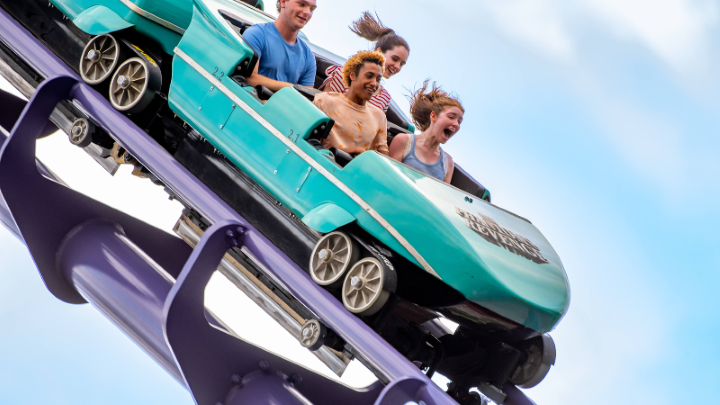
PHANTOM's REVENGE
2001
Back to top
Kennywood
4800 Kennywood Boulevard
West Mifflin, PA 15122
412-461-0500
|
|